
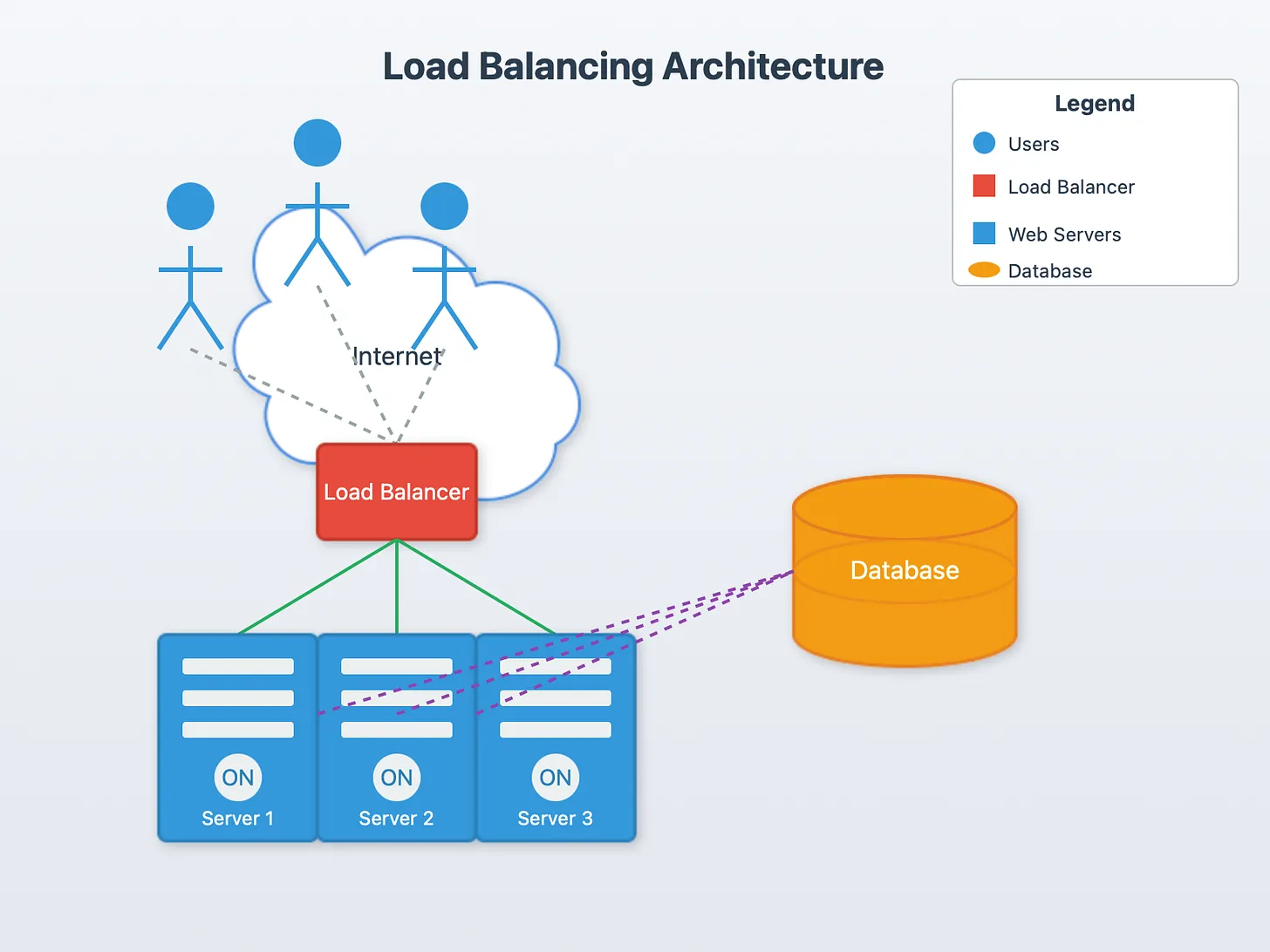
Load balancing is the art of distributing network traffic efficiently across multiple servers to ensure no single server becomes overwhelmed. Let's explore this critical technology that powers most of the modern web applications you use daily.
Load Balancing Architecture

Core Load Balancing Algorithms
1. Round Robin

The simplest and most widely implemented algorithm distributes requests sequentially across servers in rotation. Client requests are assigned to each server in turn, creating an even distribution pattern.
Ideal for: Environments with servers of similar capabilities handling requests of consistent complexity.
Limitation: Doesn't account for varying server capacity or request complexity.
2. Least Connections

This algorithm directs traffic to the server with the fewest active connections. It's more sophisticated than Round Robin as it considers each server's current load.
Ideal for: Applications with varying request complexity or duration, where some connections might tie up server resources longer than others.
Implementation detail: The load balancer maintains a counter of connections for each server, routing new requests to the least busy node.
3. Weighted Algorithms

Both Round Robin and Least Connections have weighted variants where servers are assigned different weights based on their capacity. Higher-capacity servers receive proportionally more traffic.
Real-world application: When your infrastructure mixes different server sizes (e.g., small, medium, large instance types in the cloud).
4. IP Hash

This method generates a hash from the client's IP address to determine which server receives the request. The same client always routes to the same server, ensuring session persistence.
Critical for: Applications requiring sticky sessions where a user's session data is stored on a specific server.
Load Balancing Algorithm Comparison

Advanced Load Balancing Techniques
Dynamic Load Balancing
Modern load balancers adapt in real-time to changing server conditions:
Least Response Time: Directs traffic to servers with the lowest combination of active connections and response time.

Resource-Based: Monitors CPU, memory, and network utilization to make intelligent routing decisions.

Geographic Load Balancing
For global applications, Geographic DNS directs users to the closest data center, reducing latency and improving user experience.

Implementation in Action
Netflix uses sophisticated load balancing to serve millions of concurrent video streams. Their system combines several algorithms to ensure smooth video delivery even during peak viewing hours.
Amazon's elastic load balancing switches between algorithms based on traffic patterns, scaling from handling a few requests to millions during Black Friday sales.
Popular Load Balancing Solutions
HAProxy: Open-source software load balancer with high performance and reliability
NGINX: Web server that excels at load balancing and reverse proxy functions
F5 BIG-IP: Enterprise-grade hardware solution with advanced traffic management
AWS Elastic Load Balancing: Cloud-based service with application, network, and gateway load balancing
Implementation Considerations
When implementing load balancing:
Health checks are crucial for detecting and removing failed servers from the pool
Session persistence ensures users maintain consistent connections to specific servers
SSL termination at the load balancer offloads encryption overhead from application servers
By thoughtfully selecting and configuring your load balancing algorithm, you'll create resilient systems that can handle traffic spikes without performance degradation. The right approach depends on your specific application needs, but understanding these algorithms provides the foundation for high-availability architecture design.
Related articles

11 Networking Concepts Explained in 11 Minutes
Learn 11 essential networking concepts every software engineer should know, from IP addresses and DNS to TCP/IP, routers, firewalls, and cloud networking. Understand how networks work with simple explanations and real-world examples.
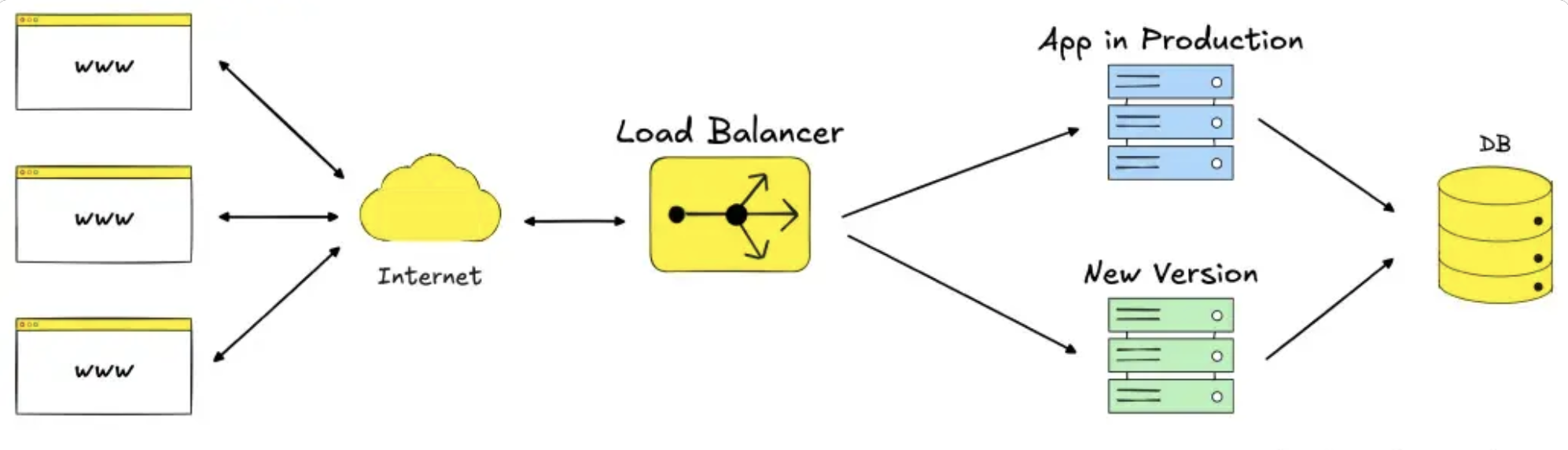
Blue-Green Deployment: Strategy, Benefits, and Best Practices
Learn how Blue-Green Deployment enables zero-downtime releases, faster rollbacks, and safer software updates. Explore its architecture, benefits, challenges, and popular tools.